DRUGS / POISONS / MEDICINES
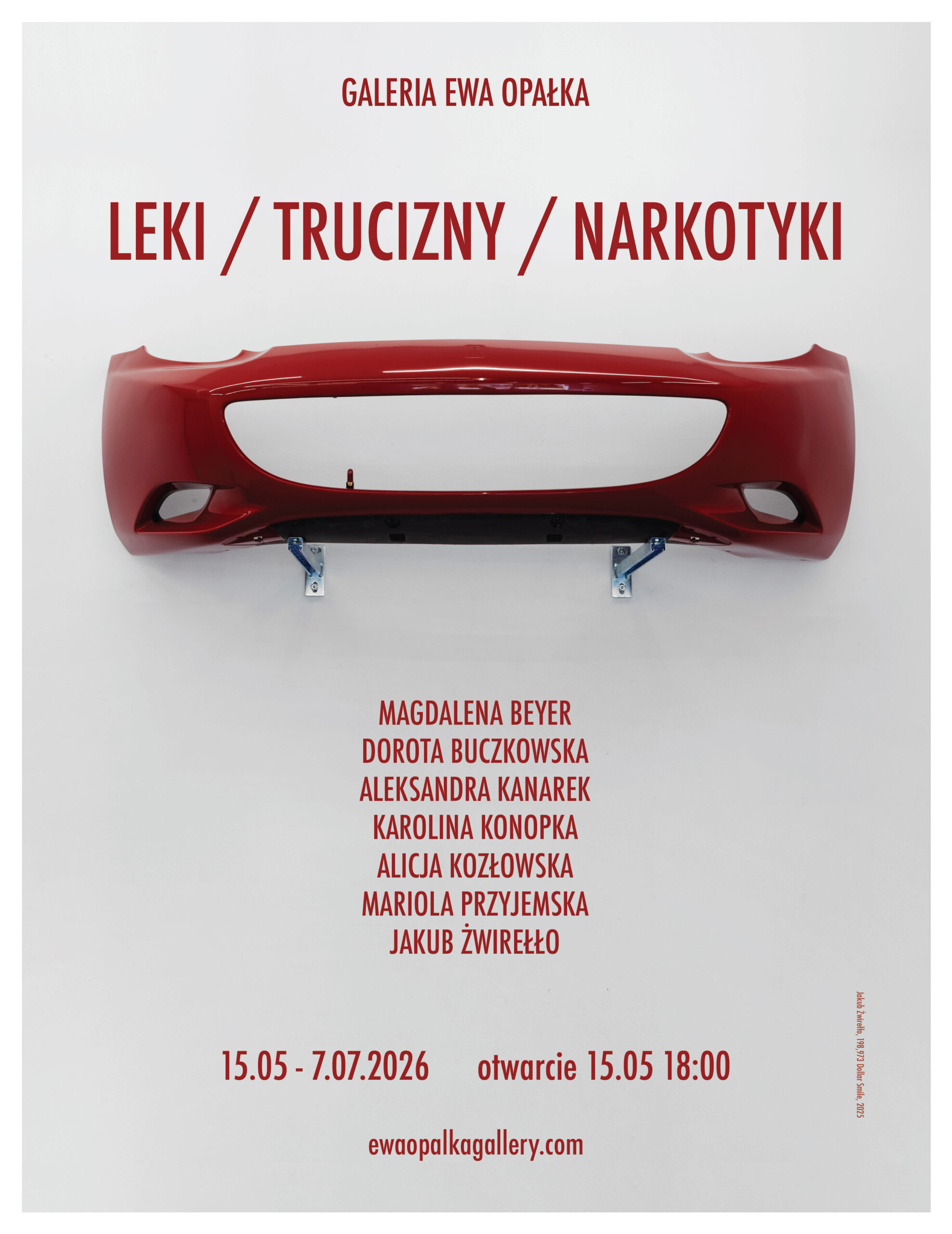 The title of the exhibition is drawn from a historic sign mounted on the façade of a tenement building at the entrance to the Museum of Pharmacy in Warsaw. Today, this juxtaposition may appear ambiguous, even internally contradictory. In fact, however, it reveals historically grounded connections between medicinal, toxic, and intoxicating substances—present both in medical practices and in cultural, economic, and political orders.
The history of these substances unfolds in parallel with the history of civilization—across centers and peripheries, at the intersection of the West and the Orient. The exhibition proceeds from the assumption that medicines, poisons, and drugs do not constitute separate categories, but rather form a fluid spectrum in which the meaning of a substance shifts depending on the context of use, systems of power, and dominant social narratives.
The narrative of the entanglement of healing, intoxication, and poisoning opens with the Opium Wars (1839–1842, 1856–1860)—a moment when psychoactive substances became tools of imperial violence and economic control. The attempt to open the Chinese market to the opium trade by British colonial interests led to mass addiction and a profound social crisis. At the same time, it revealed that substances can function as geopolitical instruments—serving both domination and destabilization.
Contemporary tensions along the East–West axis in many ways repeat this pattern. In U.S. public discourse, responsibility for the opioid crisis is often attributed to China as a supplier of chemical precursors. Much less frequently addressed is the role of Western pharmaceutical corporations in the production and distribution of substances leading to addiction. The circulation of medicines, poisons, and drugs thus reveals not only market mechanisms, but also asymmetries of power and responsibility.
The exhibition proposes a non-orthodox division into three parts, corresponding to the categories contained in the historical sign. Each of them examines how the same substances can function simultaneously as a means of healing, an instrument of poisoning, or a medium of intoxication—depending on context, dosage, and mode of use.
The first level of the exhibition focuses on narcotic and hypnotic effects—inducing states of relief, intoxication, or temporary detachment from reality, yet not necessarily linked to healing. This category includes both psychoactive substances such as alcohol, and materials operating on the threshold between utility and addiction, such as gasoline or sugar.
In this section, references to late consumer culture and practices described as supply-chain art gain particular significance. In Jakub Żwirełło’s Nothing Keeps (2025), a gasoline canister made of beeswax and amber dust reveals the material and symbolic infrastructures of energy and its economic circulation. Mariola Przyjemska’s photographic series Spirits (1999–2003), in turn, presents luxury brands as seductive objects—promising transcendence while remaining embedded in mechanisms of addiction and escapism.
An important thread in this section is also formed by works addressing sugar—a substance both ubiquitous and socially accepted, yet addictive and potentially destructive. In the works of Karolina Konopka and Alicja Kozłowska, sweets and processed snacks become emblems of capitalist pleasure and a “sugar high” that masks its own consequences.
The two remaining aspects of the effects of substances—the medicinal and the lethal—are framed as a spectrum stretched between life and death: between the decision to sustain physical existence and the possibility of bringing it to an end. The work by Dorota Buczkowska is a recording of the EEGs of two individuals—the artist and her partner—captured during orgasm. Stimulating as well as soothing substances appear here in a physiological, hormonal dimension.
The porcelain painterly objects by Aleksandra Kanarek depict biological forms in which the boundaries between healing, poisoning, and intoxication become blurred. Microscopic structures take on shapes reminiscent of cosmic icons—biology is transformed here into a process of transition from materiality to a hallucinatory vision. Magdalena Beyer’s work Substance, in turn, is a variation on perfume—olfactory formulas that contain something of an alchemical and magical process, in which diverse, often seemingly canceling essences ultimately create a harmonious and hypnotic whole.
***
Magdalena Beyer – graduate of the Faculty of Painting and Graphic Arts at the Academy of Fine Arts in Gdańsk. Alongside painting, drawing, photography, and film, scent constitutes an important medium in her artistic practice—treated not as an addition, but as an integral part of the work, activating an additional dimension of perception.
Selected solo exhibitions:
2025 – I Have a Knife in My Hand, Studio Jaskółka, Warsaw, curator: Ewa Opałka
2025 – I Have a Knife in My Hand, Hotel Warszawa Art Faire, Warsaw
2024 – Don’t Follow Me, Kopernika 6, Warsaw
2024 – Let’s Go Upstairs, Hotel Warszawa Art Faire, Warsaw
2024 – Buty na basenie (Shoes at the Swimming Pool), Starzyński Dwór
2022 – Idę 2 (I’m Going 2), Ogrody Geyera, Łódź, curator: Małgorzata Paszylka Glaza
2022 – Akwarium (Aquarium), Pracownia Marszałkowska, Warsaw
2021 – Idę (I’m Going), WL4 Mleczny Piotr, Gdańsk, curator: Małgorzata Paszylka Glaza
Selected group exhibitions:
2024 – Oswajanie plastikowej kałuży (Taming the Plastic Puddle), Galeria 63, Warsaw.
Dorota Buczkowska – born in 1971 in Warsaw. A graduate of the Academy of Fine Arts in Warsaw, she is one of the most important artists in Poland. She was a student in the class of prof. Grzegorz Kowalski at the Faculty of Sculpture of The Academy of Fine Arts in Warsaw (1999– 2003), and also studied at the Faculty of Conservation and Restoration of Works of Art at the same academy (1991–1998), and at Gender Studies at the University of Warsaw (2002). Her internship in the prestigious Centre National des Art Plastiques Villa Arson in Nice (2002– 2003), along with several exhibitions – at the Polish Institute in 2003, at the CRAC in Sète in 2008, at Le Fresnoy in 2009, and at the Fondation d’enterprise Pernod Ricard the in 2011 – put her on the map of the arts in France. Dorota Buczkowska uses different means of expressions: painting, drawing, graphics, sculpture, video, photography and installations. In her works she often looks into subjects of circulation of matter in nature, treating it as a space for metaphorical exploration, sometimes tinged with surrealism and poetic subtlety. She is absorbed in the physiology and subjectivity of plants, the constant transformation of human and non-human bodies. She employs metaphors grounded in physiology, representing abstract shapes that suggest biological structures, processes of circulation, and in general living organisms interrelated in a kind of ecosystem in which color, gesture, light, and matter are combined in different textures and formations. She lives and works in Romania.
Grants & residences: 2011 Award at the Biennale Lorne Sculpture, Australia,
2011 Pro Helvetia CRIC Sierre Center,
2010 Pollock Krasner Foundation Grant,
2007 Residence in Tel – Aviv, The Polish Season in Israel,
2005 Artist in Residence, Center for Contemporary Art, Synagogue of Delme,
2004 Artist in Residence, Bundeskanzleramt – Federal Chancellery, Vienna,
2003 French Scholarship in Centre National des Arts Plastiques Villa Arson, Nice.
Works in collections: Raffles Europejski Hotel Warsaw Collection, Zachęta National Gallery of Art, Warsaw, Stradom House Art Collection, Polish Art Foundation ING, PKO S.A Collection, Warsaw, Museum of the Sculpture, Marl, State Collection Vienna, MoBY- Bat Yam Museum,Tel –Aviv.
Aleksandra Kanarek – (b. 2002, Koszalin) is a visual artist based in Warsaw. She graduated with a BA from the Faculty of Media Art at the Academy of Fine Arts in Warsaw, where she is currently pursuing her MA. As part of a scholarship, she is continuing her studies at the École nationale supérieure des Arts Décoratifs in Paris, while also studying Cultural Studies at the University of Warsaw. Her practice spans photography, video, painting, sculpture, and installation. Combining visual practice with research-based inquiry, she explores the biological and symbolic mechanisms of inheritance as well as processes of transformation. Selected exhibitions and projects: Medicines / Poisons / Drugs, Ewa Opałka Gallery, Warsaw, 2026; Art in Non-Places, Foundation for the Development of Creative Society, 2026; Tsukimi, Ewa Opałka Gallery, Warsaw, 2025; National Student Review of Short Film Forms, Dramatic Theatre, Warsaw, 2025; We Don’t Sleep, Bliska 12 Pavilion, Warsaw, 2025; Hope in the Dark, Promocyjna Gallery, Warsaw, 2025; Quo Vadis, 29th International Poster Biennale in Warsaw, 2025; Ahoj Cinema, 3Kino Art Pasáž, Prague, 2024; 34th Musica Polonica Nova, National Forum of Music, Wrocław, 2024; PRE/TEXTS, Museum of Polish Song, Opole, 2024; Visionary, Polish Institute Gallery, Sofia, 2024; Roots, 28th International Poster Biennale in Warsaw, Institute of Industrial Design Gallery, Warsaw, 2023.
Karolina Konopka – graduate of Painting in the studio of Prof. Dr. Andrzej Tobis at the Academy of Fine Arts in Katowice. Scholarship holder of the Minister of Culture of 2019. She works in the field of: video, painting, sculpture, installation. She is interested in confectionery art, delicatessen art, the issue of mass culture, consumerism, discarded food as well as those on the plate, rituals, traditions and rituals rooted in Polish culture. He searches the Internet, lumpxes and dumpsters and catalogs the things he finds there.
Selected exhibitions: Tortology, BWA Katowice, Katowice, 2020, Lower Biscuit, Dobro Gallery, Olsztyn, 2020, …give us today, Arsenal Gallery, Bialystok, 2021, AKCES – REACTIONS | Exhibition of the VII Competition of the Best Diplomas of Media Art, Wroclaw, 2021, Best Diplomas of the Academy of Fine Arts 2020, Gdansk, 2021, Strabag Artaward International, Strabag Kunstforum, 2021, Triennale of the Young, Orońsko, 2020, Where are the jams? BWA Zielona Góra, 2020, Simple gestures, BWA Katowice, Katowice, 2020, Sex, suicide, socialism, spirit and stereotypes, CCA Kronika, Bytom, 2019, Bielska Jesień, BWA Bielska Gallery, Bielsko-Biała, 2019, EQUINOX, Brick City Gallery, Springfield, USA, 2019, Sweet nausea, Galeria Szara, Katowice, 2019, ZÜPA, Galeria Rotor2, Göteborg, Sweden, 2019.
Alicja Kozłowska is an award-winning artist and designer based in Poland, renowned for her innovative approach to textile art and embroidery. With a strong foundation in design, she holds a “Graphic Design” diploma from the Wojciech Gerson State High School of Fine Arts in Warsaw and a degree in “Domestic Design” from the School of Form University, also in Warsaw. These academic achievements laid the groundwork for her distinctive style, which seamlessly blends traditional craftsmanship with modern artistic expression. Her works have been exhibited in prestigious galleries and museums across Europe and the United States, including The LAM Museum (Lisse, Netherlands), Danubiana Meulensteen Art Museum (Bratislava, Slovakia), MOCAK (Cracow, Poland), Gallery1988 (Los Angeles, USA), Unit London (London, England), and Palazzo Velli Expo (Valtopina, Italy). In 2021 Alicja works have been recognized and awarded by the prestigious Hand & Lock Prize for Embroidery. In 2022, she received the “Stypendium Ministra,” a ministerial scholarship awarded for outstanding achievements in the arts. In 2024, she was chosen to represent Poland in „Homo Faber Fellowship” program organised by Michelangelo Foundation. Her work has been featured in numerous prominent publications, including Designboom, Colossal, Textileartist, Elle Decoration, and many others. Her passion is broadly understood textile art and handicraft. Drawing inspiration from everyday life, she seeks to redefine and elevate the perception of fiber art and embroidery, transforming these traditional techniques into contemporary, thought-provoking works of art.
Mariola Przyjemska – born 1963 in Warsaw, is a multimedia artist who creates paintings, photographs and films. She graduated from the Academy of Fine Arts in Warsaw. In 1988, she defended her diploma in the painting studio of Tadeusz Dominik, as well as an annex in installations in Ryszard Winiarski’s studio. The exhibition presenting diploma works took place in the same year, in the Warsaw Gallery Dziekanka. At the begining of her creative practice, in the so-called mystical period, Przyjemska concentrated mostly on ecstatic, neo-expressionist paintings, although already during her studies she did not avoid performances and installations, in which she made use of the fire element. The mystical period was both a time to search for the means of expression for a non-orthodox spirituality, and a time to seek one’s own identity as a woman artist. In her paintings, created with a limited colour-palette that brings to mind alchemical flames, we can find references to both antique and Christian iconography; references to old masters, as well as to pre-war and post-war avant-garde.
In early 1990s, new elements appear, making references to oriental architecture and the Mediterranean Basin, expressing spiritual and cultural search on the edge between Oriental and Western influences. Since around 1993, the artist’s interests focused on applied textiles, and later on a specific part of them: the clothing labels. Initially, the motif of a clothing label started appearing in her paintings, then she audaciously incorporated them in large format photographs that allowed her to blow up those tiny objects to the size of street banners. Apart from zooming in, the artist modified their images – showing the reverse side resembling contemporary abstract painting, removing or adding letters, and creating ambiguous messages. In the next decades of her practice, Przyjemska alternated between paintings and photography, with a sporadic addition of film, always making reference to the existing trends in historical and contemporary art: constructivism, minimalism, pop-art, in cycles such as Różnica i powtórzenie, Obrazy greckie, Kosmetyki, Muzeum Sztuki Nowoczesnej w Warszawie, Warszawa w budowie, Jazy, Rondo ONZ, Victoria’s Secret, czy Sky Sawa. At the same time, Przyjemska comments on the economic, social and political transformation happening in Poland since mid-1980s.
Jakub Żwirełło – (b. 1991, Olsztyn) is a visual artist and musician based in Poznań. He works across installation, including sound installations, sculpture, video, and performance, exploring the intersections of nature, technology, and culture under conditions of late capitalism. His practice reflects on the commodification of experience and the tensions between everyday life and systems of production and communication. Alongside his visual work, he is active as a composer, producer, lyricist, and performer. He has played nearly 500 concerts, including around 350 with the band Wezasy, and has directed over 30 music videos for Polish artists. He teaches at the Institute of Intermedia at Magdalena Abakanowicz University of the Arts Poznan, combining artistic practice with pedagogy and collaborative projects.
Education: 2020–2025 — Magdalena Abakanowicz University of the Arts Poznan; 2023 — Bachelor’s degree in the studio of Prof. Piotr Kurka; 2025 — Master’s degree in the studio of Prof. Piotr Kurka, diploma consultant Dr. Daniel Koniusz.
Selected Exhibitions: Prima Materia Collection, Tesser House, Poznań; Prima Materia, Polski Teatr Tańca, Poznań; Anestetyka, Galeria Design, Poznań; Tęcza Grawitacji, t/P, Poznań; Ciepło i Tanio, Galeria u Jezuitów, Poznań; Hear the Voice, Hotel Bazar, Poznań; Antymaterie, Poznań; Hubbub, Wołyńska 9, Poznań; Festiwal Nowej Sztuki Labirynt 2023, Słubice / Frankfurt an der Oder; Noise oznacza odgłos, szum, zakłócenia, Curators’LAB, Poznań; an error has occurred, JAP, Poznań; Masa Krytyczna #2, Laboratorium, Stocznia Cesarska, Gdańsk; Wpływ przestrzeni dźwiękowych na ludzki mózg: człowiek, maszyna, natura, Domie; Sonics & Scenics, Muzeum Sztuki Nowoczesnej w Warszawie; 45. Konkurs im. Marii Dokowicz na Najlepszy Dyplom UAP, Stary Browar, Poznań. Other: CERN, Switzerland — studio visit; UAP–ZHdK Partnership Workshop, Val Müstair; 198,973 Dollar Smile, 2025.